
INDOOR JUNGLE
For the Love of Orchids
The plants I thought were far too difficult turned out to thrive on patience, a little neglect, and second chances.
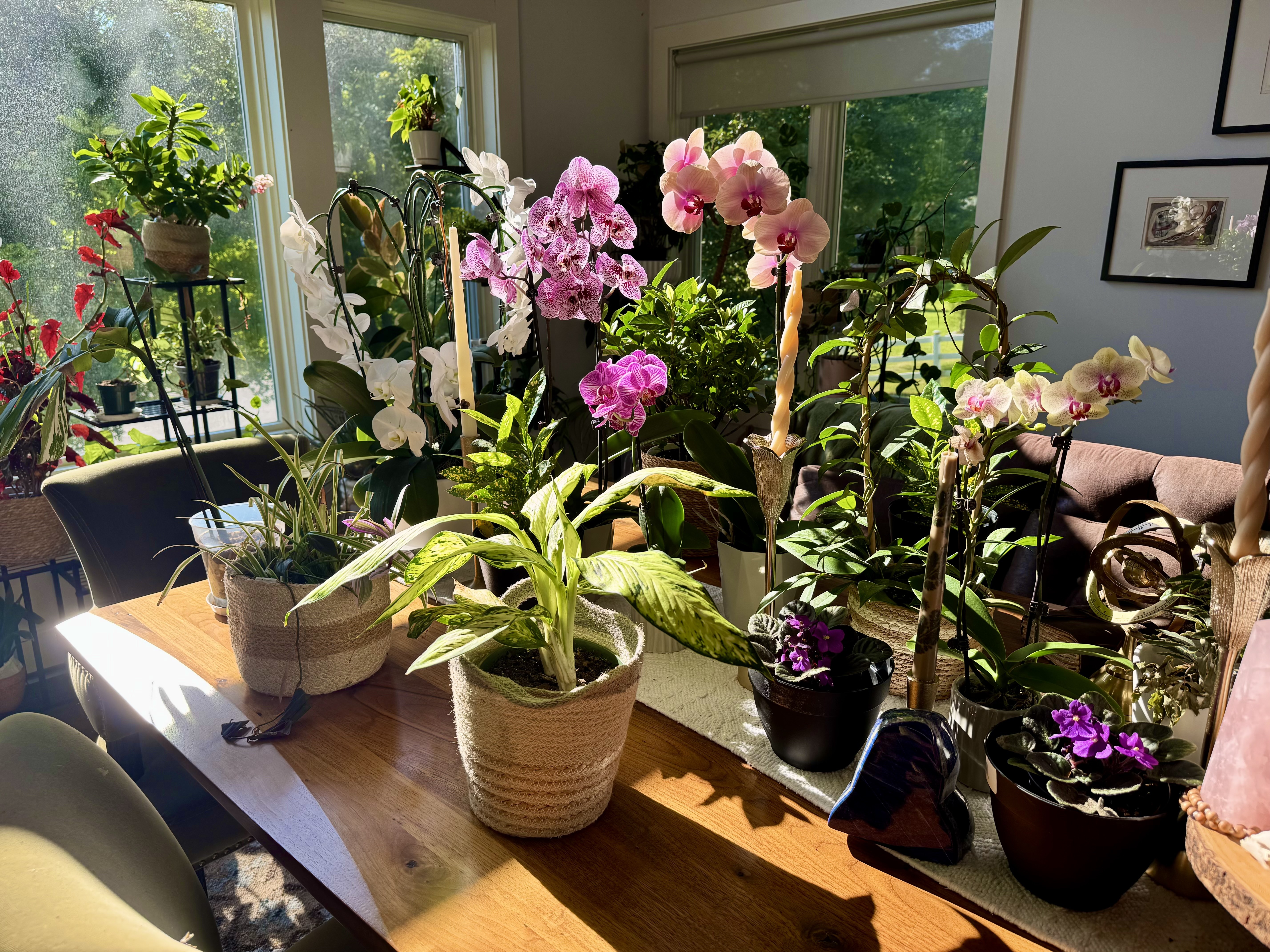
I absolutely love orchids. Which is funny, because I used to be afraid to grow them.
They seemed like one of those plants meant for people who really knew what they were doing. Serious plant people. People with humidity meters and perfect windows and an instinctive understanding of aerial roots.
Definitely not me. But my daughter kept buying them for me.
She would find a beautiful orchid on sale and bring it home because she knew I would love it. She also knew that I would almost always rather receive a living plant than cut flowers. Flowers are beautiful, of course, but there is something about having a plant remain afterward. Something you can care for and watch change over time.
Every time she handed me another orchid, though, part of me thought:
Oh no.
They were gorgeous. And surely I was going to kill them. I didn’t really know what to do with them. How much water did they need? What happened after all those beautiful flowers fell off? Was that it? Was the plant finished blooming forever?
Orchids seemed delicate, complicated and far too advanced for me. Except they weren’t.
Over time, mostly through trial and error, I discovered that orchids are surprisingly forgiving. In fact, one of the things they seem to appreciate most about me is that I occasionally forget about them.
I am not an enthusiastic over-waterer. Quite the opposite. A plant sometimes has to wave a metaphorical little flag and remind me that it exists. As it turns out, my orchids are perfectly fine with this arrangement.
Most of the orchids sold as houseplants, especially Phalaenopsis or moth orchids, would much rather dry out a bit between waterings than sit constantly wet. Their roots need air as much as they need moisture, which explains why they are usually planted in chunky bark rather than ordinary potting soil.
Suddenly my forgetfulness wasn’t a character flaw. It was an orchid-care strategy.
The Part That Really Surprised Me
Then I learned that when an orchid finishes blooming, it isn’t necessarily finished. It is resting. That changed everything for me.
I kept caring for them after the flowers faded. I gave them light. I watered them when they needed it. I started fertilizing them. And eventually, there it was. A new flower spike. Then buds. Then blooms.
There is something especially satisfying about an orchid blooming again in your home. The first flowers were already there when you bought it. But the next ones? Those feel different.
You lived through the quiet part with the plant. You cared for what looked like nothing much happening at all. And then one day it bloomed again. Beautifully. And when orchids do bloom, they really commit to it. That is another thing I love about them: the flowers last an almost ridiculous amount of time.
A bouquet of cut flowers can be beautiful for a week or two, but an orchid can sit there blooming away for weeks and sometimes months, looking almost exactly as lovely as the day the first flower opened.
Every time I think surely the blooms must be almost finished, they just keep going. That alone makes them one of my favorite flowering plants to have around the house.
A Little Trick for the Quiet Times
Of course, eventually the flowers do fade. And then you are left with the green part of the plant while it gathers itself for another round. I actually like that part now because I know what is happening. The orchid isn’t failing. It is simply between performances.
But I do have one little trick I use while I’m waiting. I have a few very realistic silk orchid stems that I tuck into a couple of my plants when they aren’t blooming. Not every orchid. And nothing dramatic. Just a stem here or there to add a little color and interest while the real plant is resting.
I don’t try to make the whole house look as though every orchid is permanently in bloom. That would feel a little too much. But a believable flower stem tucked into one or two pots? Absolutely. It keeps a little color in the room while I wait for the real thing. And eventually the orchid takes over again.
What I’ve Learned About Orchid Care
My orchid routine is fairly simple.
Give them bright, indirect light.
A bright window is wonderful, but harsh afternoon sun can scorch their leaves. Mine seem happiest with plenty of light without spending hours baking in direct sunshine.
Let them dry a little between waterings.
With many Phalaenopsis orchids, the roots are one of the best clues. Healthy wet roots are often green, while roots that are ready for water become more silvery gray. I also pay attention to how dry the bark feels rather than watering automatically according to the calendar.
When you water, actually water them.
I prefer to give the pot a thorough drink and then let all the excess water drain away. Orchids generally don’t want to sit with their roots submerged in water. I also try not to leave water pooled in the crown where the leaves meet.
Forget the Ice Cube
I know the instructions on some orchids tell you to give them a few ice cubes every week. I don’t.
These are tropical plants. Ice isn’t exactly part of their natural morning routine. If you desperately want to follow the ice-cube measurement, melt the cubes in a cup next to the orchid and give it the water tomorrow. Personally, I just use room-temperature water.
Feed them, especially while they’re actively growing.
I use an orchid fertilizer at a diluted strength rather than assuming they can survive indefinitely on water and good intentions. They don’t need enormous amounts of fertilizer, but regular light feeding can help support healthy roots, leaves and future blooms.
Don’t throw them away when the flowers fall.
This may be the most important lesson orchids taught me. Finished blooming does not mean finished living.
Keep caring for the plant. Watch for new root growth, new leaves and eventually another flower spike. Depending on the orchid and its growing conditions, patience may be required. Sometimes quite a lot of patience. But that makes the flowers even better when they finally arrive.
Repot when the bark begins breaking down.
Orchid bark doesn’t last forever. Over time it becomes softer and holds more moisture, which means less air around the roots. Every year or two, or whenever the potting mix has significantly deteriorated, I check whether an orchid would benefit from fresh orchid bark and a slightly roomier pot. And don’t panic about roots growing outside the pot. Those strange wandering aerial roots are completely normal.
The Less Charming Side of Orchids
Some of my orchids have now been with me for years. I’ve lost a few along the way. Plants do occasionally die, despite our best efforts. And orchids have introduced me to one particular nemesis: scale.
Scale insects like to hide along leaves, stems and all those little orchid crevices where they are remarkably easy to overlook. I have been fighting an ongoing battle with them on a few plants.
When I find scale, I isolate the plant if possible, inspect it carefully, remove the insects I can see, and keep checking it regularly because one treatment rarely seems to be the end of the story.
Plant ownership occasionally involves less serene communing with nature and more staring suspiciously at the underside of leaves. Sometimes it feels like war against these little invaders.
Such is gardening.
Plants That Changed My Mind
I think that’s one reason I’ve grown so fond of orchids. They changed my idea of what an “advanced” plant looks like. I assumed difficult plants required constant attention. Orchids taught me something almost opposite. Pay attention, yes. Learn what the plant needs. But then give it some space. Let it rest.
Don’t mistake a quiet season for failure. Don’t keep pouring water onto something just because you’re nervous that you aren’t doing enough. And trust that sometimes life is still happening when you can’t see much evidence of it.
I’m so glad my daughter kept ignoring my orchid anxiety and buying them for me anyway.
She just bought me another one the other day. And this time, instead of thinking Oh no, what am I going to do with this? I was simply delighted.
Apparently, somewhere along the way, I became an orchid person.